An official website of the United States government

Here’s how you know

Official websites use .gov
A .gov website belongs to an official government organization in the United States.

Secure .gov websites use HTTPS
A lock ( ) or https:// means you’ve safely connected to the .gov website. Share sensitive information only on official, secure websites.

GSA Logo U.S. General Services Administration
    • Explore buy through us
    • Category management
    • Government property for sale or lease
      Toggle submenu
      • Personal property (tangible goods)
      • Real property (real estate and buildings) for public use
      • Real property sales
      • Vehicle sales
    • Products and services
      Toggle submenu
      • Human capital
      • Industrial products and services
      • Office management
      • Professional services
      • Security and protection
      • Transportation and logistics services
    • Purchasing programs
      Toggle submenu
      • Assisted acquisition
      • Commercial platforms
      • Federal strategic sourcing initiative
      • Fleet management
      • HCaTS and HCaTS SB
      • OASIS and OASIS SB
      • Requisition programs
      • State and local programs
      • Emergency acquisition basic ordering agreements
    • Shared services
      Toggle submenu
      • Payroll services
      • Support services for CABs

    Featured Topics

    • Multiple Award Schedule Governmentwide contracts for products and services at volume discount pricing.
    • Auctions Federal assets available via auction to the general public.
    • Explore sell to government
    • Step 1: Learn about government contracting
      Toggle submenu
      • Ways you can sell to government
      • How to access contract opportunities
      • Conduct market research
    • Step 2: Compete for a contract
      Toggle submenu
      • Register your business
      • Certify as a small business
      • Become a schedule holder
      • Market your business
      • Research active solicitations
      • Respond to a solicitation
      • What to expect during the award process
    • Step 3: Manage your contract
      Toggle submenu
      • Comply with contractual requirements
      • Handle contract modifications
      • Monitor past performance evaluations

    Featured Topics

    • Contract opportunities on SAM.gov Search current federal contract opportunities and procurement notices.
    • Forecast of contracting opportunities Anticipated contracts offered by GSA.
    • Vendor support center Research the federal market, report sales, and upload contract information.
    • Explore real estate
    • Design and construction
      Toggle submenu
      • 3D-4D building information modeling
      • Computer-aided design standards
      • Engineering
      • Project management information system
      • Prospectus thresholds
    • Facilities management
      Toggle submenu
      • Security
      • Tenant services
      • Water quality management
    • Our properties
      Toggle submenu
      • Owned and leased properties
      • Renting property
    • Real estate services
      Toggle submenu
      • Leasing resources
      • Real property disposal
      • Reimbursable services (RWA)
      • For businesses seeking opportunities
      • For workers in federal buildings
      • Voice of the customer
    • Workplace optimization
      Toggle submenu
      • Commercial coworking
      • Space Match
    • Explore historic buildings

    Featured Topics - Real Estate

    • Historic preservation tools and resources Procedures for maintaining and repairing historic buildings.
    • Real property disposal Dispose or acquire excess federal real property including buildings or land.
    • Explore policy and regulations
    • Acquisition policy
    • Aviation management policy
    • Federal Advisory Committee Act management
    • Information technology policy
    • Real property management policy
    • Travel management policy
    • Regulations
      Toggle submenu
      • Federal acquisition regulations
      • Federal management regulations
      • Federal travel regulations

    Featured Topics

    • Forms Search for a government form.
    • Per diem FAQs Frequently asked questions about per diem rates and related topics.
    • Explore small business
    • Small business goals
    • Register your business
      Toggle submenu
      • Explore business models
      • Research the federal market
      • Subcontracting and other partnerships
    • Forecast of contracting opportunities
    • Small business resources
      Toggle submenu
      • Small business contacts
      • Videos

    Featured Topics

    • Forecast tool Information on planned federal contracting opportunities.
    • Socio economic categories Check your eligibility for small-business set-asides.
    • Training resources Suggested training for doing business with us.
    • Explore travel
    • Plan a trip
      Toggle submenu
      • Per diem rates
      • Transportation (airfare rates, POV rates, etc.)
      • Lodging
      • Travel charge card
    • Travel and lodging services
      Toggle submenu
      • E-gov travel service (ETS)
      • Rideshare
      • Travel category schedule
    • Federal travel regulation

    Featured Topics

    • Per diem rates look-up Allowances for lodging, meal and incidental costs while on official government travel.
    • Mileage reimbursement rates Reimbursement rates for the use of your own vehicle while on official government travel.
    • Explore technology
    • Purchasing programs
      Toggle submenu
      • Cloud computing services
      • Cybersecurity products and services
      • Governmentwide acquisition contracts
      • MAS information technology
      • USAccess
    • Government initiatives
      Toggle submenu
      • Artificial Intelligence
      • Cybersecurity
      • Emerging citizen technology
      • FedRAMP
      • Federal identity, credentials, and access management
      • Robotic process automation community
      • Technology modernization fund
    • Training

    Featured Topics

    • Challenge.gov Government sponsored challenges and prize competitions.
    • Data.gov Access U.S. government data.
    • Multiple award schedule IT category Information technology products, services and solutions.
    • Explore about us
    • Background and history
      Toggle submenu
      • Overview
      • Mission and strategic goals
      • Role in presidential transitions
    • Careers
      Toggle submenu
      • Get an internship
      • Launch your career
      • Elevate your professional career
      • Discover special hiring paths
      • Resources and related links
    • Events and training
      Toggle submenu
      • Events, training, and request a speaker
      • Our training programs
    • Newsroom
      Toggle submenu
      • Agency blog
      • Congressional testimony
      • GSA does that podcast
      • News releases
      • Speeches
      • Videos
    • Organization
      Toggle submenu
      • Leadership directory
      • Federal Acquisition Service
      • Public Buildings Service
      • Staff offices
    • Contact us

    Featured Topics

    • Blog Read the latest GSA news, updates and analysis.
    • Careers Learn what we have to offer.
  • Per diem lookup
Buy through us
Explore buy through us
Category management
Government property for sale or lease
Personal property (tangible goods)
Real property (real estate and buildings) for public use
Real property sales
Vehicle sales
Products and services
Human capital
Industrial products and services
Office management
Professional services
Security and protection
Transportation and logistics services
Purchasing programs
Assisted acquisition
Commercial platforms
Federal strategic sourcing initiative
Fleet management
HCaTS and HCaTS SB
OASIS and OASIS SB
Requisition programs
State and local programs
Emergency acquisition basic ordering agreements
Shared services
Payroll services
Support services for CABs
Sell to government
Explore sell to government
Step 1: Learn about government contracting
Ways you can sell to government
How to access contract opportunities
Conduct market research
Step 2: Compete for a contract
Register your business
Certify as a small business
Become a schedule holder
Market your business
Research active solicitations
Respond to a solicitation
What to expect during the award process
Step 3: Manage your contract
Comply with contractual requirements
Handle contract modifications
Monitor past performance evaluations
Real estate
Explore real estate
Design and construction
3D-4D building information modeling
Computer-aided design standards
Engineering
Project management information system
Prospectus thresholds
Facilities management
Security
Tenant services
Water quality management
Our properties
Owned and leased properties
Renting property
Real estate services
Leasing resources
Real property disposal
Reimbursable services (RWA)
For businesses seeking opportunities
For workers in federal buildings
Voice of the customer
Workplace optimization
Commercial coworking
Space Match
Explore historic buildings
Policy and regulations
Explore policy and regulations
Acquisition policy
Aviation management policy
Federal Advisory Committee Act management
Information technology policy
Real property management policy
Travel management policy
Regulations
Federal acquisition regulations
Federal management regulations
Federal travel regulations
Small business
Explore small business
Small business goals
Register your business
Explore business models
Research the federal market
Subcontracting and other partnerships
Forecast of contracting opportunities
Small business resources
Small business contacts
Videos
Travel
Explore travel
Plan a trip
Per diem rates
Transportation (airfare rates, POV rates, etc.)
Lodging
Travel charge card
Travel and lodging services
E-gov travel service (ETS)
Rideshare
Travel category schedule
Federal travel regulation
Technology
Explore technology
Purchasing programs
Cloud computing services
Cybersecurity products and services
Governmentwide acquisition contracts
MAS information technology
USAccess
Government initiatives
Artificial Intelligence
Cybersecurity
Emerging citizen technology
FedRAMP
Federal identity, credentials, and access management
Robotic process automation community
Technology modernization fund
Training
About us
Explore about us
Background and history
Overview
Mission and strategic goals
Role in presidential transitions
Careers
Get an internship
Launch your career
Elevate your professional career
Discover special hiring paths
Resources and related links
Events and training
Events, training, and request a speaker
Our training programs
Newsroom
Agency blog
Congressional testimony
GSA does that podcast
News releases
Speeches
Videos
Organization
Leadership directory
Federal Acquisition Service
Public Buildings Service
Staff offices
Contact us
  1. Home
  2. Real estate
  3. Historic preservation
  4. Explore historic buildings
  5. Find a Building
  6. U.S. Land Port of Entry - Ambrose, Ambrose, ND

U.S. Land Port of Entry - Ambrose, Ambrose, ND

Location: 10935 ND-42, Ambrose, ND 58833


Land Port of Entry, Ambrose, ND

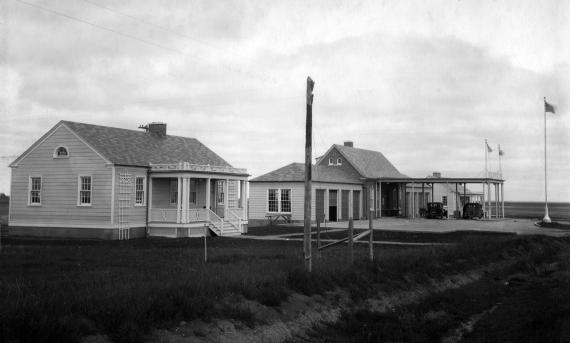
The Ambrose Port of Entry was included in the Multiple Property Submission for U.S. Border Inspection Stations and Associated Points of Entry, States Bordering Canada and Mexico (Multiple Property Submission MPS). As demonstrated in the Description section of this registration form, the Ambrose Land Port of Entry retains all aspects of integrity and meets the registration requirements in the MPS to be eligible for listing in the National Register of Historic Places under Criterion A and C, and at the state level of significance, period of significance 1932. It retains all of its original program elements, and well demonstrates the historic characteristics of Border Station MPS Property Type Number 3: 11/2 story office with garage wings and separate living quarters.

The various elements of the Ambrose program, including the primary building, the porte-cochere, and the two attached garage wings, are original and were constructed in 1932. The total building program remains completely intact, and presents an expressive example of the Colonial Revival design style. Upon the primary unit and its wings, this Colonial Revival detailing makes itself present through the combination of: a strongly symmetrical massing featuring a primary unit backed by a centered chimney and flanked by lower wings; strong symmetrical massing in the front elevation including paired and small-pane multi-glazed wood frame double hung windows on either side of a centered entry program; odd-numbered ranking across the front elevation; Tuscan influenced steel pipe columns; ogee style cornice and gable molding with gable returns at the gable ends; a Georgian inspired motif of small rectangular panes above the main entry; Flemish Course brick veneer; roof balustrades; and gauged brick jack molding with keystone above windows and main entry.

Because of the rural, if not isolated locations of many of the border stations, the main port buildings often included living quarters, either within the primary building or as standalone residences. Originally located to the north and south of the Ambrose port were two identical, freestanding T-plan, one story, side-gabled residences clad in painted wood clapboard. These structures were also of the Colonial Revival design style. The features that associated them to the Colonial Revival style include: small-pane wood frame double hung windows in a shared ranking across the entirety of all four elevations; ogee cornice and gable molding with gable returns, and framed lunette windows at the side elevations. The Colonial Revival detailing upon the residences were simple, and conveyed the utilitarian function of the residence while still conveying the Colonial Revival design style itself. The two residences were demolished in 2008.

The renderings for the Ambrose Land Port of Entry can be found at the National Archives and Records Administration (NARA). The primary building, as currently extant, possesses many features originally depicted in the front elevation rendering. These include the paired wood frame, multi-glazed double hung windows at the front elevation, original porte-cochere with roof baluster railing, hipped gabled symmetrically placed 4-bay garage wings, and a centered chimney. Though the rendering for the detached residences was relatively different than the built structures, they did appear original and unaltered at the time of their disposal and demolition, and may have been built from a different plan, which was not wholly uncommon regarding the ports of entry and their associated buildings.

The Ambrose Land Port of Entry is earlier than most of the ports cited in the Multiple Property Submission. At the time of it completion in 1932, the Acting Supervising Architect of the Treasury was James A. Wetmore, who held the position from 1915 to 1933, and whose signature is present on the Ambrose renderings. Wetmore however, had no formal architectural training, and directing Wetmore’s office during this period was Louis A. Simon, who had worked with the office continually since 1896.

In 1933, Simon became the Supervising Architect of the Treasury, a post he held until 1939. During Simon’s tenure, the Department of the Treasury was the largest architectural office in the United States, with over 700 million dollars worth of various Post Offices, Border Checkpoints, Custom Houses, and other Federal buildings. The construction of United States border stations, inspection stations, and customs and immigration inspection stations was approved by Legislation under the Act of June 25, 1910. The spate of Public Works Administration (PWA) era of construction, and the construction of this particular border station, initially resulted from the Public Buildings Act of 1926, a Congressional enabling act that doubled the number of U.S Federal buildings in existence.

The Ambrose Inspection Station evolved from the contexts of Prohibition (1919-1933), the increased popularization of automobile travel, and the Public Works Administration that developed out of the Great Depression of the 1930s. The Ambrose Inspection Station projects an iconographic image of American architecture at the international border. It features the Colonial Revival design system often used for Governmental buildings during this time; one that was consciously associated to the American heritage and American past since the 1876 Centennial celebration which triggered a desire for an understanding of American architectural lineage.

Significance within the related Multiple Property Submission

The Ambrose Land Port of Entry was included in the Border Station MPS. The Ambrose Land Port of Entry is significant within all three historic contexts identified in the Border Station MPS, as follows:

“Within historic context no. 1, U.S. Border Stations, History and Function, the U.S. Border Inspection Stations (Land Ports of Entry) designed from 1930-1939 and constructed from 1931-1943, are associated with a series of important events in United States history that would qualify them for inclusion in the National Register of Historic Places under Criterion A. :

  • The passage of the Volstead Act and the ratification of the 18th Amendment, which prohibited the sale and consumption of alcoholic beverages between 1919 and 1933, that led to increased smuggling across international boundaries
  • Enactment of the Keyes-Elliot Public Buildings Act of 1926 that funded construction of U.S. Government Buildings in many states
  • The increase in public mobility from the popularity and affordability of the automobile in the 1920s, that changed the volume of traffic entering the U.S. from water ports-of-entry to land border crossings.

Within historic context no. 2, U.S. Post Offices, Courthouses, Federal Buildings and other government buildings designed and constructed by the Treasury Department, 1864-1939, and historic context no. 3, U.S. Border Stations, Inspection Stations, and Customs and Immigration Inspection Stations, U.S. Borders with Canada and Mexico, 1931-1943, U.S. Border Inspection Stations represent an important and distinguishable property type related by function, location, chronological era, and design characteristics that would qualify them for inclusion in the National Register of Historic Places under Criterion C. The common function was that the buildings were used as U.S. Border Stations, containing the functions of inspection, customs, immigration, or quarantine. The common location was that the stations were along the U.S. international boundaries with Canada and Mexico, or a major port of entry near the international boundary. The chronological era was quite narrow, 1930-1940 for design during the era of the Public Works Administration and 1931 to 1943 for construction. The common design was based on a series of five basic plans developed and designed by the Supervising Architect of the Treasury, that varied according to the specific size and function of the property.

Designs dating between 1930 and 1940 have been identified for at least 59 Border Inspection Stations, and at least 48 of these constructed between 1931 and 1943 are believed to still exist as of the year 2006. This is by far the largest and most cohesive group of U.S. Border Inspection Stations that share reason for authorization, design, plan, era, and function. The U.S. Inspection Station—Ambrose, North Dakota, is representative of one of the property types identified in the Border Station MPS: Property Type Number 3: 1 ½ story office with garage wings and separate living quarters. The Property Type Number 3 design was used often and appears in extant Inspection Stations not only in North Dakota but also in Vermont, New York, Maine, and once in California, where it is done in the Spanish Colonial Revival style. Most of the type-3 designs were done in the northern states. The steep pitch roof combined and brick cladding of the primary building have been referred to as “Northern Style” design qualities in regards to the border stations. Such designs are ubiquitous in the northern states, where these features allow the building to buffer the affects of cold climates, rain, and snow.

According to the Registration Requirements of the Border Station MPS, to be considered at a state level of significance, the main building must retain all seven aspects of integrity.” As demonstrated in the Description section of this registration form, the Land Port of Entry —Ambrose, North Dakota retains all aspects of integrity and meets the registration requirements in the MPS to be eligible for listing in the National Register of Historic Places under Criterion A and C, and at the state level of significance, period of significance 1932.

*** National Register nomination

Facts

  • Architect: James A. Wetmore
  • Construction Date: 1932 
  • GSA Building Number: ND0501AK
  • Landmark Status: Listed in the National Register of Historic Places 

Print Page Email Page
Last updated: Jan 31, 2025
Top

Home

  • Resources for …
    • Americans with Disabilities
    • Citizens and Consumers
    • Federal Employees
    • GSA Employees
    • Native American affairs
    • Presidential & Congressional Commissions, Boards or Small Agencies
    • Small Business
  • Governmentwide Initiatives
    • Centers of Excellence
    • Digital experience
    • Emergency response
    • Federal Cybersecurity
    • ID, Credentials, and Access Management
    • Information Quality
    • Open Data
    • Technology Modernization Fund
  • Contact Us
  • Organization
    • Leadership Directory
    • Staff Directory
  • References
    • Annual reports
    • Plain Language
    • Budget and Performance
    • Catalogs
    • Orders & Directives
    • Forms
  • Website Information
    • A-Z Index
    • Report a website issue
    • Sitemap
  • Also of Interest
    • Data.gov
    • Whitehouse.gov
  • Tools
    • eBuy
    • eLibrary
    • Contracting forecast tool
    • GSA Advantage
    • GSA Auctions
GSA logo
  • Facebook
  • X
  • LinkedIn
  • YouTube
  • instagram
  • Blog
  • email

JOIN THE CONVERSATION

GSA.gov

An official website of the U.S. General Services Administration

  • Accessibility statement
  • Website Policies
  • Reports
  • Office of the Inspector General
  • No FEAR Act
  • FOIA Requests
  • Board of Contract Appeals
Looking for U.S. government information and services?
Visit USA.gov

PER DIEM LOOK-UP

1 Choose a location

Error, The Per Diem API is not responding. Please try again later.

No results could be found for the location you've entered.

Get my location

OR

OR

Rates for Alaska, Hawaii, and U.S. territories and possessions are set by the Department of Defense.

Rates for foreign countries are set by the Department of State.

2 Choose a date


OR

Rates are available between 10/1/2023 and 09/30/2026.

The End Date of your trip can not occur before the Start Date.


Additional terms and conditions

Traveler reimbursement is based on the location of the work activities and not the accommodations, unless lodging is not available at the work activity, then the agency may authorize the rate where lodging is obtained.

Unless otherwise specified, the per diem locality is defined as "all locations within, or entirely surrounded by, the corporate limits of the key city, including independent entities located within those boundaries."

Per diem localities with county definitions shall include"all locations within, or entirely surrounded by, the corporate limits of the key city as well as the boundaries of the listed counties, including independent entities located within the boundaries of the key city and the listed counties (unless otherwise listed separately)."

When a military installation or Government - related facility(whether or not specifically named) is located partially within more than one city or county boundary, the applicable per diem rate for the entire installation or facility is the higher of the rates which apply to the cities and / or counties, even though part(s) of such activities may be located outside the defined per diem locality.