An official website of the United States government

Here’s how you know

Official websites use .gov
A .gov website belongs to an official government organization in the United States.

Secure .gov websites use HTTPS
A lock ( ) or https:// means you’ve safely connected to the .gov website. Share sensitive information only on official, secure websites.

GSA Logo U.S. General Services Administration
    • Explore buy through us
    • Category management
    • Government property for sale or lease
      Toggle submenu
      • Personal property (tangible goods)
      • Real property (real estate and buildings) for public use
      • Real property sales
      • Vehicle sales
    • Products and services
      Toggle submenu
      • Human capital
      • Industrial products and services
      • Office management
      • Professional services
      • Security and protection
      • Transportation and logistics services
    • Purchasing programs
      Toggle submenu
      • Assisted acquisition
      • Commercial platforms
      • Federal strategic sourcing initiative
      • Fleet management
      • HCaTS and HCaTS SB
      • OASIS and OASIS SB
      • Requisition programs
      • State and local programs
      • Emergency acquisition basic ordering agreements
    • Shared services
      Toggle submenu
      • Payroll services
      • Support services for CABs

    Featured Topics

    • Multiple Award Schedule Governmentwide contracts for products and services at volume discount pricing.
    • Auctions Federal assets available via auction to the general public.
    • Explore sell to government
    • Step 1: Learn about government contracting
      Toggle submenu
      • Ways you can sell to government
      • How to access contract opportunities
      • Conduct market research
    • Step 2: Compete for a contract
      Toggle submenu
      • Register your business
      • Certify as a small business
      • Become a schedule holder
      • Market your business
      • Research active solicitations
      • Respond to a solicitation
      • What to expect during the award process
    • Step 3: Manage your contract
      Toggle submenu
      • Comply with contractual requirements
      • Handle contract modifications
      • Monitor past performance evaluations

    Featured Topics

    • Contract opportunities on SAM.gov Search current federal contract opportunities and procurement notices.
    • Forecast of contracting opportunities Anticipated contracts offered by GSA.
    • Vendor support center Research the federal market, report sales, and upload contract information.
    • Explore real estate
    • Design and construction
      Toggle submenu
      • 3D-4D building information modeling
      • Computer-aided design standards
      • Engineering
      • Project management information system
      • Prospectus thresholds
    • Facilities management
      Toggle submenu
      • Security
      • Tenant services
      • Water quality management
    • Our properties
      Toggle submenu
      • Owned and leased properties
      • Renting property
    • Real estate services
      Toggle submenu
      • Leasing resources
      • Real property disposal
      • Reimbursable services (RWA)
      • For businesses seeking opportunities
      • For workers in federal buildings
      • Voice of the customer
    • Workplace optimization
      Toggle submenu
      • Commercial coworking
      • Space Match
    • Explore historic buildings

    Featured Topics - Real Estate

    • Historic preservation tools and resources Procedures for maintaining and repairing historic buildings.
    • Real property disposal Dispose or acquire excess federal real property including buildings or land.
    • Explore policy and regulations
    • Acquisition policy
    • Aviation management policy
    • Federal Advisory Committee Act management
    • Information technology policy
    • Real property management policy
    • Travel management policy
    • Regulations
      Toggle submenu
      • Federal acquisition regulations
      • Federal management regulations
      • Federal travel regulations

    Featured Topics

    • Forms Search for a government form.
    • Per diem FAQs Frequently asked questions about per diem rates and related topics.
    • Explore small business
    • Small business goals
    • Register your business
      Toggle submenu
      • Explore business models
      • Research the federal market
      • Subcontracting and other partnerships
    • Forecast of contracting opportunities
    • Small business resources
      Toggle submenu
      • Small business contacts
      • Videos

    Featured Topics

    • Forecast tool Information on planned federal contracting opportunities.
    • Socio economic categories Check your eligibility for small-business set-asides.
    • Training resources Suggested training for doing business with us.
    • Explore travel
    • Plan a trip
      Toggle submenu
      • Per diem rates
      • Transportation (airfare rates, POV rates, etc.)
      • Lodging
      • Travel charge card
    • Travel and lodging services
      Toggle submenu
      • E-gov travel service (ETS)
      • Rideshare
      • Travel category schedule
    • Federal travel regulation

    Featured Topics

    • Per diem rates look-up Allowances for lodging, meal and incidental costs while on official government travel.
    • Mileage reimbursement rates Reimbursement rates for the use of your own vehicle while on official government travel.
    • Explore technology
    • Purchasing programs
      Toggle submenu
      • Cloud computing services
      • Cybersecurity products and services
      • Governmentwide acquisition contracts
      • MAS information technology
      • USAccess
    • Government initiatives
      Toggle submenu
      • Artificial Intelligence
      • Cybersecurity
      • Emerging citizen technology
      • FedRAMP
      • Federal identity, credentials, and access management
      • Robotic process automation community
      • Technology modernization fund
    • Training

    Featured Topics

    • Challenge.gov Government sponsored challenges and prize competitions.
    • Data.gov Access U.S. government data.
    • Multiple award schedule IT category Information technology products, services and solutions.
    • Explore about us
    • Background and history
      Toggle submenu
      • Overview
      • Mission and strategic goals
      • Role in presidential transitions
    • Careers
      Toggle submenu
      • Get an internship
      • Launch your career
      • Elevate your professional career
      • Discover special hiring paths
      • Resources and related links
    • Events and training
      Toggle submenu
      • Events, training, and request a speaker
      • Our training programs
    • Newsroom
      Toggle submenu
      • Agency blog
      • Congressional testimony
      • GSA does that podcast
      • News releases
      • Speeches
      • Videos
    • Organization
      Toggle submenu
      • Leadership directory
      • Federal Acquisition Service
      • Public Buildings Service
      • Staff offices
    • Contact us

    Featured Topics

    • Blog Read the latest GSA news, updates and analysis.
    • Careers Learn what we have to offer.
  • Per diem lookup
Buy through us
Explore buy through us
Category management
Government property for sale or lease
Personal property (tangible goods)
Real property (real estate and buildings) for public use
Real property sales
Vehicle sales
Products and services
Human capital
Industrial products and services
Office management
Professional services
Security and protection
Transportation and logistics services
Purchasing programs
Assisted acquisition
Commercial platforms
Federal strategic sourcing initiative
Fleet management
HCaTS and HCaTS SB
OASIS and OASIS SB
Requisition programs
State and local programs
Emergency acquisition basic ordering agreements
Shared services
Payroll services
Support services for CABs
Sell to government
Explore sell to government
Step 1: Learn about government contracting
Ways you can sell to government
How to access contract opportunities
Conduct market research
Step 2: Compete for a contract
Register your business
Certify as a small business
Become a schedule holder
Market your business
Research active solicitations
Respond to a solicitation
What to expect during the award process
Step 3: Manage your contract
Comply with contractual requirements
Handle contract modifications
Monitor past performance evaluations
Real estate
Explore real estate
Design and construction
3D-4D building information modeling
Computer-aided design standards
Engineering
Project management information system
Prospectus thresholds
Facilities management
Security
Tenant services
Water quality management
Our properties
Owned and leased properties
Renting property
Real estate services
Leasing resources
Real property disposal
Reimbursable services (RWA)
For businesses seeking opportunities
For workers in federal buildings
Voice of the customer
Workplace optimization
Commercial coworking
Space Match
Explore historic buildings
Policy and regulations
Explore policy and regulations
Acquisition policy
Aviation management policy
Federal Advisory Committee Act management
Information technology policy
Real property management policy
Travel management policy
Regulations
Federal acquisition regulations
Federal management regulations
Federal travel regulations
Small business
Explore small business
Small business goals
Register your business
Explore business models
Research the federal market
Subcontracting and other partnerships
Forecast of contracting opportunities
Small business resources
Small business contacts
Videos
Travel
Explore travel
Plan a trip
Per diem rates
Transportation (airfare rates, POV rates, etc.)
Lodging
Travel charge card
Travel and lodging services
E-gov travel service (ETS)
Rideshare
Travel category schedule
Federal travel regulation
Technology
Explore technology
Purchasing programs
Cloud computing services
Cybersecurity products and services
Governmentwide acquisition contracts
MAS information technology
USAccess
Government initiatives
Artificial Intelligence
Cybersecurity
Emerging citizen technology
FedRAMP
Federal identity, credentials, and access management
Robotic process automation community
Technology modernization fund
Training
About us
Explore about us
Background and history
Overview
Mission and strategic goals
Role in presidential transitions
Careers
Get an internship
Launch your career
Elevate your professional career
Discover special hiring paths
Resources and related links
Events and training
Events, training, and request a speaker
Our training programs
Newsroom
Agency blog
Congressional testimony
GSA does that podcast
News releases
Speeches
Videos
Organization
Leadership directory
Federal Acquisition Service
Public Buildings Service
Staff offices
Contact us
  1. Home
  2. Real estate
  3. Historic preservation
  4. Explore historic buildings
  5. Find a Building
  6. Federal Building, Port Angeles, WA

Federal Building, Port Angeles, WA

Location: 138 W 1st St, Port Angeles, WA 98362

Significance

Federal Building, Port Angeles WA

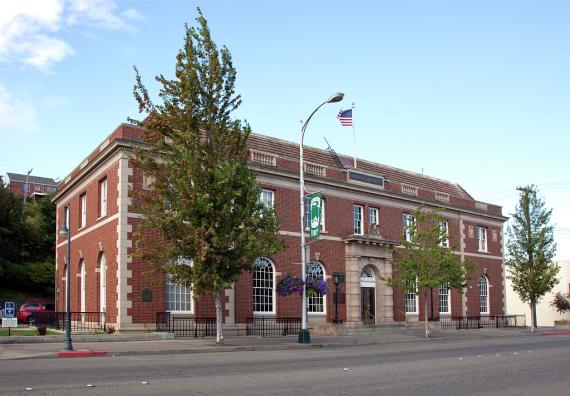
The Port Angeles Federal Building, completed in 1933, is architecturally and historically significant. Its construction followed almost 30 years of civic effort to obtain a federal building in the city. Constructed originally to house a US Post Office and various federal agencies, today it stands as a well-preserved example of a classically-derived “mongrel.” The exterior facade is a combination of Georgian, Federal and Renaissance Revival styles.

Located at the mouth of the Strait of Juan de Fuca, Port Angeles is protected by a natural sand spit that extends across the waterfront of the city. The city of Port Angeles, now the commercial center of the Olympic Peninsula, was originally a sandy refuge discovered by early Spanish, Greek and English explorers in their search for trade routes. It was named by Spanish explorer Francisco Eliza in 1791. He called it “Puerto de Nuestra Senora de los Angeles” or “Port of our Lady of the Angels.” The first white settlers arrived in 1857 and soon began trading with the Hudson Bay Company located across the Strait at Victoria, British Columbia.

Port Angeles has the distinguished characteristic as having been once the “second national city,” Washington, D.C. being the first. This distinction is largely due to the efforts of Victor Smith, a special agent of the US Treasury from 1861 to 1862. Smith persuaded President Abraham Lincoln to sign an executive order designating the two townsites of Port Angeles and Ediz Hook a federal reserve for public use, reserved for a lighthouse and military purposes. A second executive order directed that the 3,520 acres should be withheld from “sale or location of any kind whatsoever.”

Creation of the federal reserve, however, restricted settlement in the area. In 1889, when the Washington territory achieved statehood, many of the region’s settlers moved from the shore areas into the reserved timberland to live as “squatters.” The town won election as the seat for Clallum County in 1890. In the early 1890s, the government opened the reserve and auctioned lots, for a minimum of $5, giving squatters rights to purchase their claims. However, a number of lots were kept in reserve, and it is on some of this property that the Federal Building was later constructed.

The industrial era in Port Angeles, supported by the timber industry, has its origins in the collaboration of the Chicago Milwaukee St. Paul and Pacific Railroad and Crown Zellerbach Corporation in 1912 to service the demand for lumber in California and abroad. As the pulp and paper, plywood and related forest product industries expanded, the town of Port Angeles continued to grow.

Ironically, the “second national city” did not have a federal building when it was designated. In 1913, the first efforts were made to secure a federal building for the town. It was not until 1931, following World War I, that a site for a federal building was finally chosen from one of the few plots still held in the federal reserve. At that time, Congress allocated $130,000 for construction of a new U.S. Post Office and Federal Building.

The first post office had been established in early 1861 under the name Cherbourg, when Port Angeles was a small trading post. In 1862, the first official postmaster was appointed and the name Port Angeles was given to the office. Mail was brought in by canoe or sailing sloop, and distributed over the counter at a small store. Occasionally, the mail was reportedly delayed as poker-playing captains deliberately ran aground on the sand spit to finish a game. Until the construction of the new federal building, the Port Angeles Post Office did not have a permanent home. It moved from building to building as the post masters changed and as the service outgrew each subsequent existing facility.

In 2008, the building was re-dedicated to Richard B. Anderson. Born on June 26, 1921 in Tacoma, Washington, Anderson attended high school in Agnew and then graduated from Sequim High School. He joined the Marine Corps on July 6, 1942, and in January 1944 his unit—E Company, 2nd Batallion, 23rd Regiment, 4th Marine Division departed the U.S. for the Marshall Islands. On Roi Island, Private First Class Anderson was hunting enemy snipers when he threw himself on a live grenade in a shell hole to save the lives of three friends. Anderson was evacuated to a ship but died of his wounds on February 1, 1944. He was posthumously awarded the Medal of Honor and a Purple Heart.

History of the site

Although the site selected for the Port Angeles Federal Building was part of federal reserve land, a number of citizens had constructed buildings on individual lots there over the years. In early January 1931, the Deputy Customs Collector notified each of these people by letter, indicating that the property, “…owned by the United States, will be required shortly by the Government for the purpose of erecting a post office, and you are further notified to vacate said site and to remove any improvements thereon…within sixty days from the date of this notice.” A letter from the Deputy Customs Collector to the U.S. District Attorney in Seattle, dated February 25, 1931, states that all the “squatters” had removed or were in the process of removing their buildings from the site, except for a Mrs. M.E. Troy.

Minerva E. (Lewis) Troy was the daughter of Freeborn S. Lewis, who came to Port Angeles in 1887 from Omaha, Nebraska, as a physician with the Puget Sound Cooperative Colony. Dr. Lewis settled on property at First and Oak Streets, which was part of the federal reserve. He made several attempts to purchase the property (lot 8 and the eastern 16’ of lot 9, block 32), following an act of Congress that allowed settlers to apply to purchase land on which they had settled and made improvements. However, these applications were not successful because block 32 remained federal reserve property, despite other lots being released for purchase. Minerva Troy inherited the property from her father upon his death in 1917, and she continued to attempt to purchase it. When the government prepared for construction of the Federal Building on the property, Troy fought for the right to purchase the property. Unsuccessful, she finally relinquished her claim. A 1949 newspaper profile of Minerva Troy notes that in return, “union carpenters and other mechanics built her present home at 118 West Second Street.”

Facts

  • Architects: Wetmore, James A.; Louis A. Simon
  • Construction Dates: 1931-1933
  • GSA Building Number: WA0028ZZ
  • Landmark Status: Listed in the National Register of Historic Places 


Print Page Email Page
Last updated: Jan 29, 2025
Top

Home

  • Resources for …
    • Americans with Disabilities
    • Citizens and Consumers
    • Federal Employees
    • GSA Employees
    • Native American affairs
    • Presidential & Congressional Commissions, Boards or Small Agencies
    • Small Business
  • Governmentwide Initiatives
    • Centers of Excellence
    • Digital experience
    • Emergency response
    • Federal Cybersecurity
    • ID, Credentials, and Access Management
    • Information Quality
    • Open Data
    • Technology Modernization Fund
  • Contact Us
  • Organization
    • Leadership Directory
    • Staff Directory
  • References
    • Annual reports
    • Plain Language
    • Budget and Performance
    • Catalogs
    • Orders & Directives
    • Forms
  • Website Information
    • A-Z Index
    • Report a website issue
    • Sitemap
  • Also of Interest
    • Data.gov
    • Whitehouse.gov
  • Tools
    • eBuy
    • eLibrary
    • Contracting forecast tool
    • GSA Advantage
    • GSA Auctions
GSA logo
  • Facebook
  • X
  • LinkedIn
  • YouTube
  • instagram
  • Blog
  • email

JOIN THE CONVERSATION

GSA.gov

An official website of the U.S. General Services Administration

  • Accessibility statement
  • Website Policies
  • Reports
  • Office of the Inspector General
  • No FEAR Act
  • FOIA Requests
  • Board of Contract Appeals
Looking for U.S. government information and services?
Visit USA.gov

PER DIEM LOOK-UP

1 Choose a location

Error, The Per Diem API is not responding. Please try again later.

No results could be found for the location you've entered.

Get my location

OR

OR

Rates for Alaska, Hawaii, and U.S. territories and possessions are set by the Department of Defense.

Rates for foreign countries are set by the Department of State.

2 Choose a date


OR

Rates are available between 10/1/2023 and 09/30/2026.

The End Date of your trip can not occur before the Start Date.


Additional terms and conditions

Traveler reimbursement is based on the location of the work activities and not the accommodations, unless lodging is not available at the work activity, then the agency may authorize the rate where lodging is obtained.

Unless otherwise specified, the per diem locality is defined as "all locations within, or entirely surrounded by, the corporate limits of the key city, including independent entities located within those boundaries."

Per diem localities with county definitions shall include"all locations within, or entirely surrounded by, the corporate limits of the key city as well as the boundaries of the listed counties, including independent entities located within the boundaries of the key city and the listed counties (unless otherwise listed separately)."

When a military installation or Government - related facility(whether or not specifically named) is located partially within more than one city or county boundary, the applicable per diem rate for the entire installation or facility is the higher of the rates which apply to the cities and / or counties, even though part(s) of such activities may be located outside the defined per diem locality.