An official website of the United States government
Here’s how you know
Official websites use .gov
A .gov website belongs to an official government organization in the United States.
Secure .gov websites use HTTPS
A lock
()
or https:// means you’ve safely connected to the .gov website. Share sensitive information only on official, secure websites.
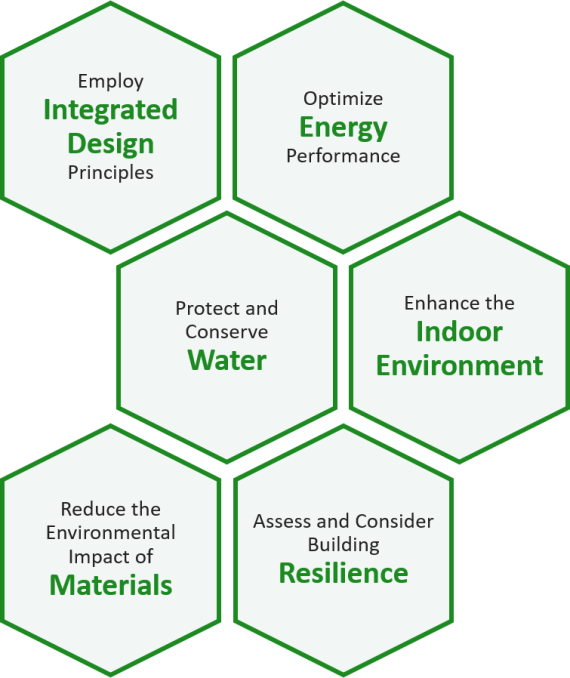
Congress has enacted a range of statutory provisions requiring high-performance federal buildings, use of “sustainable design principles,” energy, water and environmental goals, and other requirements that are advanced by the implementation of high-performance federal buildings within an agency’s portfolio. These goals are reflected in the Guiding Principles for Sustainable Federal Buildings and Associated Instructions [PDF], also referred to as Guiding Principles, which can help agencies meet federal mandates related to high-performance building design, construction, and operation.
A 2018 GSA study [PDF - 3 MB] found that high-performance buildings meeting the Guiding Principles save energy and water, cost less to operate, produce less waste, and have more satisfied occupants compared with typical buildings.
History of the Guiding Principles
In 2002, a Task Force of the White House Council on Environmental Quality, adopted high-performance buildings as one of its six priority areas and published a report, “The Federal Commitment to Green Building: Experiences and Expectations.” The Guiding Principles were established in 2006 in a memorandum of understanding signed by federal agencies at the White House. The Council on Environmental Quality subsequently issued the Guiding Principles and associated instructions in 2008. The Guiding Principles as well as the associated instructions were then updated in 2016 and most recently in 2020.
Getting started
The Guiding Principles issued in December 2020 consist of a base document with six appendices. The following steps are recommended to help you navigate this guidance:
Determine whether your building falls under the Federal Real Property Profile or FRPP reporting requirements in Appendix E [PDF]. Note that leases are not included in the reporting requirements, though agencies may choose to track sustainability of their leased buildings in FRPP. If your building does not meet the reporting criteria, check with your individual agency for guidance.
Assess
Assess your building using the appropriate pathway:
New assessment
If your building has never been assessed against any version of the Guiding Principles, start your assessment by using the appropriate checklist below:
Buildings must be reassessed every four years. Consult Appendix D [PDF] for the reassessment criteria checklist and options for reassessment using a third-party system.
High-performance federal building requirements and certification standards
Visit the high-performance green building certification systems page to learn about the benefits of using certification systems and the requirements for federal agencies that choose to use them. We have also developed resources for how certification systems can help agencies meet the Guiding Principles and how credits may align with statutory and regulatory requirements.
Total Workplace Scorecard
The Total Workplace Scorecard [XLSX - 183 KB] benchmarks and measures quality improvements between existing and new workplace conditions. It is best if the same people complete the evaluation for both existing and new workplaces. There are 100 possible points, with extra credit available to supplement the score of facilities with limiting factors.
In Appendix B — Checklist for Existing Buildings, Guiding Principle criteria 4.9, occupant health and wellness, provides agencies with the option to demonstrate that they have met the criteria by completing section 2 of the Total Workplace Scorecard [XLSX - 164 KB]. The section consists of 74 multiple choice questions, including extra credit, with instructions and resources.
42 U.S.C. §17144: OMB Government efficiency reports and scorecards
Life cycle cost resources
OMB Circular A-94 [PDF]: Guidelines and discount rates for benefit-cost analysis of federal programs
NIST-FEMP Handbook 135: Life-cycle costing manual for the Federal Energy Management Program
10 CFR 436 Part A: Methodology and procedures for life cycle cost analyses
Checklist resources
These resources for new construction and existing buildings are referenced and linked throughout the Guiding Principles for Sustainable Federal Buildings and Associated Instructions, December 2020.
Traveler reimbursement is based on the location of the work activities and not the accommodations,
unless lodging is not available at the work activity, then the agency may authorize the rate where
lodging is obtained.
Unless otherwise specified, the per diem locality is defined as "all locations within, or entirely
surrounded by, the corporate limits of the key city, including independent entities located within
those boundaries."
Per diem localities with county definitions shall include"all locations within, or entirely
surrounded by, the corporate limits of the key city as well as the boundaries of the listed counties,
including independent entities located within the boundaries of the key city and the listed counties
(unless otherwise listed separately)."
When a military installation or Government - related facility(whether or not specifically named) is
located partially within more than one city or county boundary, the applicable per diem rate for the
entire installation or facility is the higher of the rates which apply to the cities and / or counties,
even though part(s) of such activities may be located outside the defined per diem locality.


 U.S. General Services Administration