March 27, 2020
Class Deviation CD-2020-02
Correction
MEMORANDUM FOR CONTRACTING ACTIVITIES WITHIN THE PUBLIC BUILDINGS SERVICE
FROM AND DIGITALLY SIGNED BY: Jeffrey A. Koses, Senior Procurement Executive, Office of Acquisition Policy
SUBJECT: GSAR Class Deviation - Economic Price Adjustment Clause for Deregulated Electric Supplies
On this page:
Purpose
Background
Applicability
Authority
Deviation
Effective date
Cancellations
Point of contact
Attachments
1. Purpose
This memorandum approves a class deviation from the General Services Administration Acquisition Regulation (GSAR) to allow the use of a revised fixed-price with economic price adjustment clause for deregulated electric supplies.
2. Background
The existing Federal Acquisition Regulation (FAR) Economic Price Adjustment (EPA) clause for standard supplies at FAR 52.216-2 is not consistent with GSA’s needs when procuring electric supplies. Prices for these supplies vary throughout the year per methodologies set by the appropriate regulatory authority at the State or Federal level. A deviation to GSAR 516.203-4 is necessary to reflect these industry practices.
Without the deviation, GSA would be required to fix the price for all-electric supply components and require suppliers to place a risk premium on charges that are set by regulation since GSA cannot guarantee that users will remain constant over the contract term. The supplier has no control over the regulated charges.
PBS has also demonstrated through the their attached business case that the following conditions, as described in FAR 16.203-4(a)(1) apply:
- A fixed-price contract is contemplated.
- The requirement is for standard supplies that have an established catalog or market price.
- A fixed-price contract with economic price adjustment is necessary to provide for contract price adjustment in the event of changes in the contractor’s established prices.
Therefore, an agency prescribed clause is appropriate per FAR 16.203-4(a)(2). GSA PBS requested a class deviation to GSAR 516.203 Fixed-price contracts with economic price adjustment (EPA), to allow the use of an appropriate fixed-price with economic price adjustment clause for electric supplies following commercial industry practices.
3. Applicability
This class deviation only applies to the acquisition of deregulated electric supplies.
4. Authority
Following consultation with the Chair of the Civilian Agency Acquisition Council (CAAC), this class deviation is issued under the authority of FAR 1.404 and GSAR 501.404.
5. Deviation
See Attachment A for the changes in the GSAM text as revised by this deviation. The following is a summary:
- The additional prescription in 516.203-4 for GSAR clause 552.216-77 Economic Price Adjustment - Electric Supply in lieu of FAR 52.216-2.
- The addition of GSAR Clause 552.216-77.
6. Effective date
This deviation is effective immediately and remains in effect until rescinded or incorporated into the GSAR.
7. Cancellations
Not applicable.
Any questions regarding this deviation may be directed to GSARPolicy@gsa.gov.
Attachments
Attachment A – GSAM Deviation Text
Attachment B – PBS Business Case
Attachment A – GSAM Deviation Text
GSAR Baseline: Change 106 effective 02/19/2020
- Additions to baseline made by deviation are indicated by [bold text in brackets].
- Deletions to baseline made by deviation are indicated by
strikethroughs. - Five asterisks (* * * * *) indicate that there are no revisions between the preceding and following parts or sections.
Three asterisks (* * *) indicate that there are no revisions between the material shown within a section and subsection or subsection.
PART 516 - TYPES OF CONTRACTS
* * *
Subpart 516.2 - Fixed Price Contracts
* * *
516.203-4 Contract clauses.
* * *
[(c) Deregulated Electric Supply Contracts. Insert the clause at 552.216-77, Economic Price Adjustment - Electric Supply in solicitation and contracts for deregulated electric supplies instead of the FAR clause at 52.216-2, Economic Price Adjustment-Standard Supplies. The contracting officer shall insert the appropriate formulas required in paragraphs (a) and (b) of the clause.]
PART 552 - SOLICITATION PROVISIONS AND CONTRACT CLAUSES
* * * * *
Subpart 552.2 - Text of Provisions and Clauses
[552.216-77 Economic Price Adjustment-Electric Supply. As prescribed in 516.203-4(c), insert the following clause:
552.216-77 Economic Price Adjustment - Electric Supply (DATE).
In addition to the fixed price for the electric energy required for the accounts included in the contract pricing group [insert appropriate account or group of accounts], each month, the Contractor shall charge and the Government shall pay the Contractor for the accounts included in the contract pricing group [insert the appropriate account or group of accounts] an additional amount as an economic price adjustment equal to the sum of the following components:
(a) Capacity. The Government shall pay the Contractor a capacity charge in accordance with the following formula:
[The contracting officer shall insert the appropriate formula for the specific Regional Transmission Organization (RTO), which is an electric power transmission system operator that coordinates, controls, and monitors a multi-state electric grid, and is overseen by the Federal Energy Regulatory Commission (FERC).]:
(b) Transmission. The Government shall pay the Contractor a Transmission Charge in accordance with the following formula:
[The contracting officer shall insert the appropriate formula for transmission charges, if applicable (transmission charges may not be applicable to certain utility zones). If not applicable, insert “Not Applicable]:
(c) Other Market Charges and Credits. The Government shall pay and/or be credited back the following market based charges/credits as appropriate for the applicable contract and utility/RTO zone. The Contracting Officer shall identify which Other Market Charges and Credits will apply in the contract pricing section. [Include as appropriate.]
(1) Reliability Must Run (RMR) - Any RMR charges shall be with no markup to the Government.
(2) Federal Energy Regulatory Commission (FERC) Order 745 Costs - FERC Order 745 costs, if any, shall be with no mark-up to the Government.
(3) Auction Revenue Rights (ARRs) - Any ARRs associated with the account loads shall be credited back to the Government, based on the Government’s share of the Contractor’s overall load. Both the transmission charge and any credits to the Government shall be shown as separate line items on the monthly invoices. The Contractor shall apply ARR credits within 60 days of receipt by the Contractor.
(d) Changes. The Contractor shall:
(1) Notify the Contracting Officer in writing as soon as reasonably possible of a change to either of the formulas in paragraphs (a) or (b) of this clause is required during the performance of the contract. The notification shall include the effective date of the change, and the applicable formula.
(2) On the anniversary date of a multiple year contract, or at the beginning of a renewal option period, to review and represent that the formulas in paragraphs (a) and (b) of this clause, arecurrent, accurate, and complete.
(3) If the estimated value of the contract is increased or decreased as a result of paragraphs (d)(1) or (d)(2) of this clause, the Contractor shall provide a written request to the Contracting Officer, and the contract shall be modified accordingly.
(End of clause)]
* * * * *
Attachment B – PBS Business Case
MEMORANDUM FOR JEFFREY A. KOSES, SENIOR PROCUREMENT, EXECUTIVE OFFICE OF ACQUISITION POLICY
FROM: Tracy M. Marcinowski, Assistant Commissioner, Office of Acquisition Management and Andrew M. Heller, Assistant Commissioner, Office of Facilities Management
SUBJECT: Business Case in support of a class deviation for energy supplies in order to streamline procedures, realize cost savings and acquire in accordance with established commercial practices
1.0 Name of the service requesting the change
GSA Public Buildings Service (PBS) is requesting this class deviation.
2.0 Rationale supporting the need
2.1 Description of the problem or matter to be addressed
GSA PBS requests a class deviation to General Services Administration Acquisition Manual (GSAM) 516.203 Fixed-price contracts with economic price adjustment (EPA), to allow the use of an appropriate fixed-price with economic price adjustment clause for electric supplies in accordance with industry commercial practices, which would enable the Government to realize cost savings. This deviation only applies to the acquisition of deregulated electric supplies.
In accordance with the Federal Acquisition Regulation (FAR) 16.203-4(a)(2), “If all the conditions in paragraph (a)(1) of this subsection apply and the contracting officer determines that the use of the clause at 52.216-2 is inappropriate, the contracting officer may use an agency-prescribed clause instead of the clause at 52.216-2.” The economic price adjustment (EPA) clause found in FAR clause 52.216-2 Economic Price Adjustment – Standard Supplies (JAN 1997) is not appropriate for electric supply commodities due to industry specific conditions, as further described in this Business Case.
This action is requested in accordance with GSAM 501.404, Class Deviations.
The proposed effective date of the class deviation is January 1, 2020 to remain in effect until rescinded or incorporated into the GSAM.
2.2 Discussion of the benefit to the agency and/or organization
Starting in the 1980s for natural gas and the late 1990s for electricity, the monopolistic public utility industry began to deregulate. Deregulation involved unbundling portions of the historic regulated public utility service. As the market developed, it became clear that deregulated natural gas and electricity commodities were commercial items as defined in FAR 2.101. Further, GSAM 512.203(b) requires the following:
(b) Deregulated/Competitive Acquisitions for Natural Gas and Electricity. For deregulated/competitive acquisitions, the contracting officer shall use policies and procedures in FAR Part 12 and this Part 512 in conjunction with the policies and procedures in FAR 41.202 (a) and (b), the review requirements of FAR Part 41, and GSAM Part 541, as applicable.
The nature of regulated utility services and deregulated natural gas and electricity commodities is that while the service/commodity is required for each facility to be operational the exact volume required is unknown due to a variety of factors. As such, GSA has selected the indefinite-delivery requirements contract type as outlined in FAR 16.501-2(a) and further in FAR 16.503 as the appropriate contract type for deregulated energy commodities. FAR 12.207(c)(1) allows the use of indefinite-delivery contracts provided “(i) the prices are established based on a firm-fixed price or fixed-price with economic price adjustment….” However, the EPA clause prescribed in FAR 16.203-4(a) is not appropriate for electric supply commodities due to industry specific conditions, which is further described below:
Electric supply is comprised of several components. The energy portion of the supply is widely traded and there is an active futures market enabling prices to be fixed by suppliers. Certain other pricing components typically included in that fixed price are state environmental requirements as well as minor components such as ancillary services. Other components of electric supply are either regulated by the Federal government or the billing methodology is regulated but the charges are uncertain. These regulated charges include capacity, transmission, reliability must run charges, FERC Order 745 costs and auction revenue rights, as applicable. The existing FAR EPA clause is not reflective of a billing process where charges will vary throughout the year in accordance with methodologies set by an appropriate regulatory authority at the state or Federal level. A deviation to GSAM 516.203-4 is necessary to reflect these industry practices.
The deviation will provide for payment of certain electric supply charges through economic price adjustments. The rates for the charges are generally regulated at the Federal level and the volumes against which these rates apply vary on a periodic basis. Once approved, the deviation will enable GSA to purchase electric supplies in a manner that is consistent with common commercial practices. GSA will continue to fix the portion of electric supply (i.e. energy) that can be readily hedged in the marketplace and allow regulated charges to be billed with no markup. This practice will foster strong competition for energy and enable GSA to be billed with no markup for charges that are not set by the market. Without the deviation, GSA will be required to fix the price for all electric supply components and require suppliers to place a risk premium on charges that are set by regulation since GSA cannot guarantee that usage will remain constant over the contract term and the supplier has no control over the regulated charges.
Based on the above, specifically the variability in billing charges, current industry practices, and uncertainty of usage, FAR 52.216-2, would not be appropriate for deregulated electric supply contracts. Furthermore, the following conditions, as described in FAR 16.203-4(a)(1) apply:
- A fixed-price contract is contemplated.
- The requirement is for standard supplies that have an established catalog or market price.
- A fixed-price contract with economic price adjustment is necessary to provide for contract price adjustment in the event of changes in the contractor’s established prices.
Therefore, an agency prescribed clause is appropriate in accordance with FAR 16.203-4(a)(2).
3.0 Discussion of the effect, if any, on GSA’s internal operating procedures
3.1 Acquisition workforce
There are no anticipated workload impacts for GSA, its contracting officers or acquisition teams. The base contracts will continue to be awarded by the Energy Division and the regions and other agencies will continue to issue delivery orders against those contracts as is the practice today.
3.2 Another office within GSA
None.
3.3 Automated systems
There will be no impact to the financial or accounting systems. Contracts for deregulated electric and natural gas supplies are entered in EASi. Orders issued by GSA regions against those contracts are also entered in EASi with the appropriate financial information from Pegasys so that bills can be paid on a monthly basis.
4.0 Discussion of the effect on contractors or offerors
It is not anticipated that this deviation will have any effect on contractors as the class deviation request is for pricing that is common in the commercial marketplace for deregulated electric supplies. Contractors prefer not to fix all supply charges and particularly those charges that are regulated and beyond their control in terms of volume and price.
GSA currently has twenty-seven electric supply contracts with an estimated annual value of $270 million that could be affected by this deviation. The contracts are for GSA and client agency buildings located in fourteen states and the District of Columbia. Without the requested deviation, as the contracts expire, replacement contracts would be required to fix all electric supply charges without knowing what those charges may be. As a result, fully fixed price contracts could result in higher average prices as suppliers manage their increased price risk.
The clause will require the insertion of appropriate formulas for the Capacity and Transmission charges for the specific Regional Transmission Organization (RTO), which is an electric power transmission system operator that coordinates, controls, and monitors a multi-state electric grid, and is overseen by the Federal Energy Regulatory Commission (FERC).
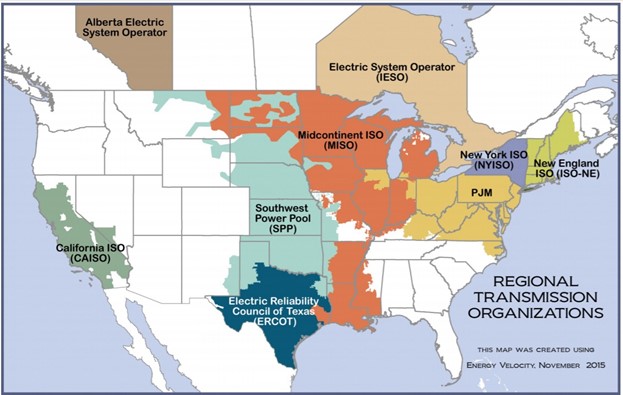
These formulas will be established at the time of award, and may be modified during the performance of the contract, as specified within the clause. Standard formulas for these charges cannot be established within the GSAM clause, as the formulas asspecific to the RTO, and are subject to change. As portrayed in the below map, there are several RTOs within the United States, covering numerous GSA and client agency buildings:
(Source: Federal Energy Regulatory Commission [PDF])
As an example, the current formulas, at the time of preparation of this business case, for Capacity and Transmission for PJM, an RTO covering 13 states and the District of Columbia, is provided below:
Capacity charges
Capacity Charge = kWCAP * FPR * FZSF * DZSF * D * FZNLP⁄1000*365
Abbreviated terms have the following meaning:
| Term | Meaning |
|---|
| kWCAP | Account’s Capacity Peak Load Contribution (PLC) in KW |
| D | Days in meter read |
| FZNLP | Applicable zone’s RPM Final Zonal Net Load Price for Load, in $/MW-Yr |
| FPR | The PJM Forecast Pool Requirement |
| FZSF | Applicable zone’s Reliability Pricing Model (RPM) Final Zonal Scaling Factor |
| DZSF | Applicable zone’s average Daily Zonal Scaling Factor for billing period |
Transmission charges
Transmission Charge = kWTrans * D * NITS+TEC⁄1000*365
Abbreviated terms have the following meaning:
| Term | Meaning |
|---|
| kWTrans | Account’s Transmission PLC (or Network Service Peak Load (NSPL)) in KW |
| NITS | Applicable zone’s Network Integration Transmission Service annual rate |
| TEC | Zonal Transmission Enhancement Project Annual Costs |
| D | Number of days within the meter read |
5.0 Analysis of alternatives, risks, and risk mitigation
Implementing this deviation will result in lower prices than GSA would obtain if a fully fixed price were the only alternative for GSA and its client agencies. If the supplier were required to fix the supply rate, then suppliers would bear the risk associated with fluctuations in capacity and transmission usage volumes and rates during the contract term. This added risk would be reflected in the contract price and GSA estimates that it would add approximately $3-4 million per year in added risk premium.
Natural gas and electric supplies for commercial buyers are priced in a variety of ways in the commercial marketplace. The pricing approach depends on facility capabilities, buyer risk tolerance, budgetary considerations, market conditions and regional variation. For large commercial buyers of electricity and natural gas, it is a common practice to “pass through” certain pricing elements at cost. For electricity, the most common so-called pass-through pricing elements are those pricing elements that remain regulated by FERC. The rates for electric transmission and capacity are demand-based charges and set each year by FERC. The rates can vary significantly from year-to-year. Neither the contractor nor the Government controls the rates. Other grid controlled charges such as reliability must run charges, FERC Order 745 costs and auction revenue rights have billing methodologies that are regulated by FERC. These charges are also commonly treated as “pass through” items since neither the Government nor the contractor controls the rates.
Each independent RTO/Independent System Operator (ISO) will have different transmission and capacity charges but all are federally regulated by the Federal Energy Regulatory Commission (FERC) under the Federal Power Act Section 205 & 206. Section 205 requires that the proposer of a revision demonstrate that the proposed rate, term or condition is just and reasonable. Section 206 requires that the proposer of a revision meet a higher burden of proof: it must demonstrate not only that the proposed change is just and reasonable, but also that the existing provisions are unjust and unreasonable.
Each RTO/ISO delegated governing body or member committee have filing authority and are required to have FERC approval to meet Section 205 and 206 regulations. Any proposed changes to the formulas and rate structure would first be vetted through the RTO governing body and once approved submitted to FERC for final approval.
As a result of the governance of the RTO and the oversight of the FERC, a “cap” or price ceiling, as similarly described in FAR 52.216-2(c)(1) would not be appropriate for the federally regulated, “pass through” transmission and capacity charges. Historically speaking, the average fluctuations to the transmission charges have been relatively insignificant. For example, when analyzing the changes to the transmission charges from a period June 2018 - January 2020, across 21 separate zones, the average variance was 2%. However, for the capacity charges, the fluctuations have historically varied from region to region, with the Northeast and Mid-Atlantic states seeing the largest changes year to year and California and Texas seeing small changes. These rate changes must be submitted and approved by FERC which ensures that the proposed rate increases are required for grid reliability and fair and equitable to the rate payers. Although the capacity charge fluctuations have varied, a “cap” or price ceiling would still not be appropriate given the regulated nature of the charges, which are outside of the Contractor’s control. The inclusion of a “cap” or price ceiling will require the Contractor to include a risk premium to the firm-fixed price commodity, resulting in a higher contract price to the Government, without any real reduction of risk. (Additional information regarding the historical data is available upon request).
Furthermore, designation of a market indicator would also not be appropriate calculating the economic price adjustment of the transmission and capacity charges given the federally regulated nature of the charges. A market indicator would be appropriate for the commodity (i.e. electricity) if this portion of the service was subject to an economic price adjustment; however the commodity is, and will continue to be, firm-fixed price.
In addition to the above, it should be noted that nearly all Federal energy commodity purchases are conducted by two sources: the Defense Logistics Agency (DLA) and the GSA, PBS, Energy Division. DLA and GSA have been conducting deregulated energy commodity purchases from the inception of natural gas and electric deregulation. DLA and GSA routinely coordinate on policy and legal matters related to energy commodity purchases and purchase energy commodities as commercial items. DLA routinely uses a variety of fixed-price methods to price energy commodities. Attachment B to this business case provides a sample DLA clause utilized to address energy charges. DLA’s model was taken into consideration when drafting the business case and proposed GSAM clause, however adjustments were made to align with GSA’s current buying and contract administration practices.
6.0 Discussion of the approach to be used to implement and monitor success
Implementation of this class deviation will allow GSA to adopt and align with industry best practices. The class deviation will be implemented on all new deregulated electric supply contracts, which are awarded and administered by the PBS Office of Facilities Management, Energy Division. In order to monitor success, PBS will continue to benchmark future prices to the commercial market pricing. Historical pricing data and future pricing data can also be compared to realize cost savings.
Additionally, the Energy Division will review each request for economic price adjustment to verify the request is in accordance with industry standards. The Energy Division will also conduct a periodic review of contractor utility bills to ensure billing accuracy. The frequency and quantity of utility bills reviewed will vary depending on the risk to the Government. The more significant the request for economic price adjustment and the larger the number of mistakes identified, the larger the scope of the review.
7.0 Proposed amendments to the FAR or the GSAM in line-in line-out format
See Attachment A.
8.0 Listing of the organizations(s), if any, that have been briefed or involved in drafting the proposed amendments
None.
9.0 Attachments
Attachment A – GSAM Deviation Line-In/Line-Out Text
Attachment B – Sample Defense Logistics Agency (DLA) Energy Clause
10. Concurrence and approvals
Statement of Legal Sufficiency
The LR legal counsel concurs that there is no legal barrier to proceeding with the proposed deviation.
Digitally signed by Brad Boettcher, Office of General Counsel, on 02/28/2020.
Approvals
Digitally signed by Andrew M. Heller, Assistant Commissioner, Office of Facilities Management, on 02/27/2020.
Digitally signed by Tracy M. Marcinowski, Assistant Commissioner, Office of Acquisition Management for Head of Contracting Activity, on 02/28/2020.
Attachment A – GSAM Deviation Line-In/Line-Out Text
GSAR Baseline: Change 105 effective 01/21/2020
- Additions to baseline made by deviation are indicated by [bold text in brackets]
- Deletions to baseline made by deviation are indicated by strikethroughs
- Five asterisks (* * * * *) indicate that there are no revisions between the preceding and following sections
- Three asterisks (* * *) indicate that there are no revisions between the material shown within a subsection
* * * * *
PART 516 - TYPES OF CONTRACTS
* * *
Subpart 516.2 - Fixed Price Contracts
* * *
516.203-4 Contract clauses.
* * *
[(d) Deregulated Electric Supply Contracts. For acquisitions of deregulated electric supply contracts, use 552.216-7X, Economic Price Adjustment - Electric Supply in lieu of FAR 52.216-2. The appropriate formulas shall be inserted in paragraphs (a) and (b) to account for regional variations.]
PART 552 - SOLICITATION PROVISIONS AND CONTRACT CLAUSES
* * * * *
Subpart 552.2 - Text of Provisions and Clauses
* * *
[552.216-7X Economic Price Adjustment—Electric Supply. As prescribed in 516.203-4(d), insert the following clause:
552.216-7X Economic Price Adjustment – Electric Supply (DATE).
In addition to the fixed price for the electric energy required for the accounts included in the contract pricing group [insert appropriate account or group of accounts], each month, the Contractor shall charge and the Government shall pay the Contractor for the accounts included in the contract pricing group [insert the appropriate account or group of accounts] an additional amount as an economic price adjustment equal to the sum of the following components:
(a) CAPACITY. The Government shall pay the Contractor a Capacity Charge in accordance with the following formula:
[Insert the appropriate formula for the Regional Transmission Organization (RTO)]
(b) TRANSMISSION. The Government shall pay the Contractor a Transmission Charge in accordance with the following formula:
[Insert the appropriate formula for transmission charges, if applicable (transmission charges may not be applicable to certain utility zones)]:
(c) OTHER MARKET CHARGES AND CREDITS. The Government shall pay and/or be credited back the following market based charges/credits as appropriate for the applicable contract and utility/RTO zone. The Contracting Officer shall identify which Other Market Charges and Credits will apply in the contract pricing section. [Include as appropriate.]
(1) Reliability Must Run (RMR) – Any RMR charges shall be with no markup to the Government.
(2) Federal Energy Regulatory Commission (FERC) Order 745 Costs – FERC Order 745 costs, if any, shall be with no mark-up to the Government.
(3) Auction Revenue Rights (ARRs) – Any ARRs associated with the account loads shall be credited back to the Government, based on the Government’s share of the Contractor’s overall load. Both the transmission charge and any credits to the Government shall be shown as separate line items on the monthly invoices. The Contractor shall apply ARR credits within 60 days of receipt by the Contractor.
(d) CHANGES.
(1) If a change to the Capacity or Transmission formulas in paragraphs (a) or (b) of this clause is required during the performance of the contract, the Contractor shall notify the Contracting Officer in writing as soon as reasonably possible. The Contractor shall provide the effective date of the change with this notification.
(2) In addition to the notification in (d)(1), the Contractor is required, on the anniversary date of a multiple year contract, or at the beginning of a renewal option period, to review and represent that the Capacity and Transmission formulas in (a) and (b) of this clause, are current, accurate, and complete.
(3) If the estimated value of the contract is increased or decreased as a result of (d)(1) or (d)(2), the Contractor shall provide a written request to the Contracting Officer, and the contract shall be modified accordingly.
(4) Changes to the contract will be made in accordance with this clause and the clause at FAR 52.212-4 Contract Terms and Conditions - Commercial Items. No modification increasing the contract price shall be executed under this paragraph (d) until the Contracting Officer verifies the increase in the applicable established price.
(End of clause)]
* * * * *
Attachment B – Sample Defense Logistics Agency (DLA) Energy Clause
The below sample clause is an example of a similar clause utilized by DLA Energy for deregulated electric supply contracts. Similar to the GSAR clause, the formulas are inserted for the appropriate Regional Transmission Organization (RTO).
B802 Locational marginal price (electricity) (DLA Energy JAN 2009)
The total amount charged by the Contractor (for accounts listed in [BUYER INSERT APPLICABLE ATTACHMENT III FILE NAME] each month shall equal the sum of the following components:
(a) ENERGY. For each hour of the month, the Government shall pay the Contractor the product of the [BUYER INSERT REAL-TIME OR DAY-AHEAD] Locational Marginal Price (LMP) for the [BUYER INSERT APPLICABLE ZONE/AGGREGATE] through which the account t is served [BUYERINSERT WHETHER METERED LOAD FOR THE ACCOUNT SHOULD BE INCREASED FOR LINE LOSSES] to the same [BUYER INSERT APPLICABLE ZONE/AGGREGATE].
(b) TRANSACTION FEE. The Government shall pay the Contractor the product of a fixed fee multiplied by the account’s total energy consumption in that month. Payment of this fee shall compensate the Contractor for all services performed, as well as [BUYER INSERT APPLICABLE COSTS ASSOCIATED WITH THE TRANSACTION FEE (BASED ON THE REGION BEING SOLICITED)]. The price of the fixed fee shall remain constant throughout the contract term.
(c) OTHER MARKET CHARGES. All other charges, not included in the Energy or Transaction Fee components, are identified below. [BUYER INSERT OTHER CHARGES ALONG WITH CALCULATION METHODOLOGY AS REQUIRED].
(d) INDICES. In the event that the [BUYER INSERT APPLICABLE RTO/ISO] LMP or any other index upon which any energy price for this contract is determined ceases to publish or is substantially altered in derivation or application (including, but not limited to, the elimination of price caps), the parties shall agree upon a substitute index. If the parties fail to agree on an appropriate substitute index, the matter shall be resolved in accordance with paragraph (d), Disputes, of the CONTRACT TERMS AND CONDITIONS – COMMERCIAL ITEMS clause of the contract.


 U.S. General Services Administration